If you have ever felt a surge of frustration when a relatively new appliance breaks down, a favorite sweater unravels after a single wash, or a smartphone battery mysteriously dies just as the warranty expires, you are not alone. You are experiencing the sharp end of a modern crisis: a throwaway culture where products are intentionally designed to fail. We are surrounded by a disposable product culture that drains our wallets, clutters our landfills, and leaves us feeling complicit in a cycle of endless, wasteful consumption.
But there is an alternative. Welcome to the “Adamantine Mindset”—a definitive framework for rejecting low-quality manufacturing and reclaiming your purchasing power. This is not just another list of trendy products; it is a masterclass in identifying durable luxury goods and “Buy It For Life” (BIFL) investment pieces. In this comprehensive guide, we will explore the historical roots of disposable culture, define the science of imperishable design, deconstruct true luxury craftsmanship, and equip you with a proprietary “Durability Scorecard” to ensure your next purchase is engineered for eternity.
- The Crisis of Quality: Escaping the Disposable Product Culture
- Defining ‘Adamantine’: The Philosophy of Imperishable Design
- The Anatomy of Luxury Craftsmanship & Timeless Design
- The Practical Masterclass: Identifying Investment Pieces with Durable Design
- Building a Legacy Portfolio: The Financial Case for Timeless Design Investments
- Conclusion
- References & Authoritative Sources
The Crisis of Quality: Escaping the Disposable Product Culture
To understand the value of imperishable design, we must first confront the antagonist of our story: the modern crisis of quality. The disposable product culture we live in today is not an accident; it is a carefully engineered economic model. The shift began significantly in the mid-20th century, heavily driven by the plastics industry. Initially, plastics were marketed as durable, reusable miracles of modern science. However, to drive continuous sales and exponential profit, the industry deliberately shifted its strategy to promote cheap, single-use disposability [1].
This shift birthed the “psychology of disposability.” According to academic journals on consumer systems thinking, our society has developed a convenience bias, severing our emotional connection to our belongings and normalizing the act of throwing things away simply because it is easier than repairing them [2].
The Planned Obsolescence Problem: A Historical ‘Hall of Shame’
The engine driving this disposable culture is the planned obsolescence problem. Planned obsolescence is the intentional design of a product with a limited useful lifespan, forcing the consumer to make repeat purchases. This is not a modern consumer conspiracy theory; it is a documented historical business strategy.
The most infamous example belongs to the Phoebus cartel. In 1925, major lightbulb manufacturers colluded to intentionally reduce the lifespan of incandescent bulbs from a standard 2,500 hours down to a strict 1,000 hours to artificially boost sales [3]. The concept was later formalized in academic and economic circles, notably in real estate broker Bernard London’s 1932 paper, Ending the Depression Through Planned Obsolescence, which argued that the government should impose legal lifespans on consumer goods to stimulate the economy [4].
Today, the consequences of this model are catastrophic. Contrived durability and the prevention of repairs have led to a massive environmental crisis. Research published in PubMed Central (PMC) highlights that Waste of Electrical and Electronic Equipment (WEEE), or e-waste, is currently one of the fastest-growing waste streams in the EU and globally, leaching toxic materials into the environment [5].
The Hidden Costs of Low-Quality Manufacturing: The Iceberg Model
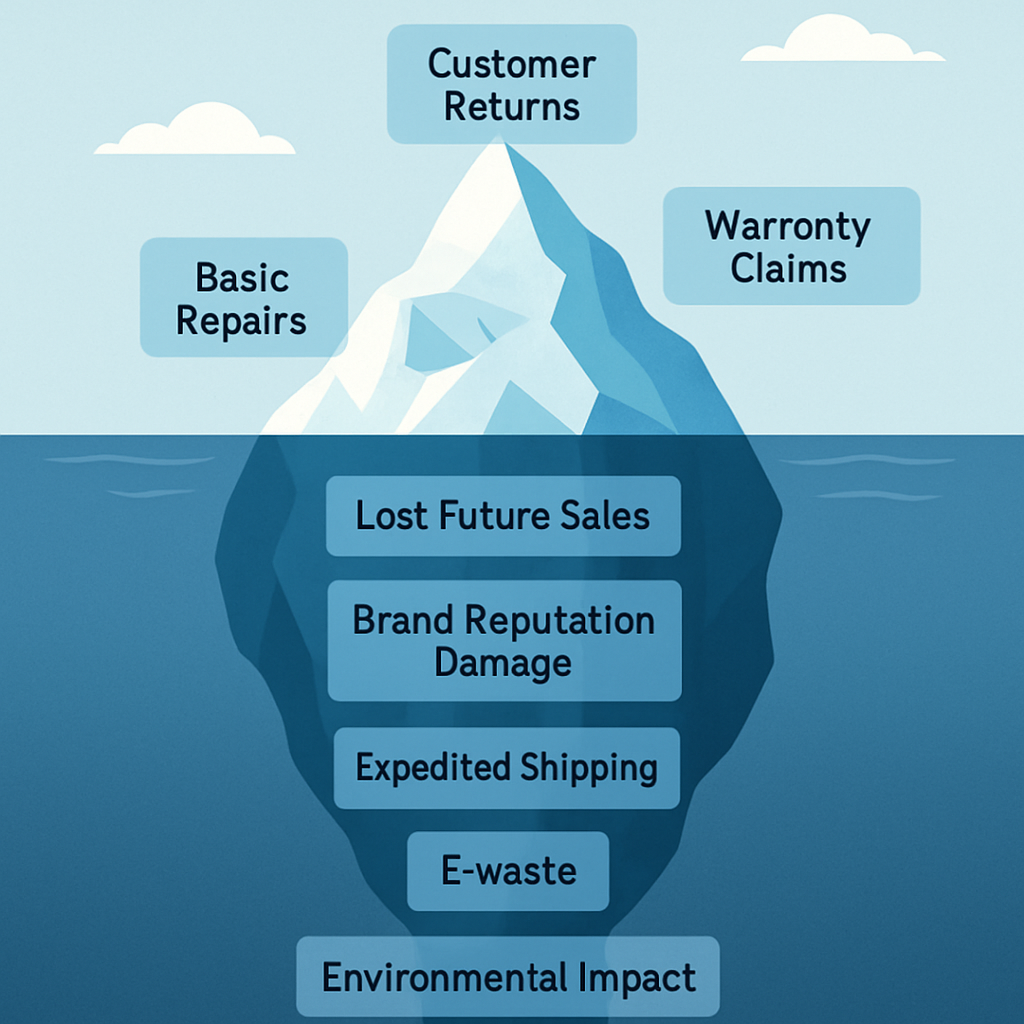
For businesses and consumers alike, low quality manufacturing is a financial sinkhole. Quality professionals estimate that the Cost of Poor Quality (COPQ) averages a staggering 15% to 20% of sales revenue for many organizations, with some experiencing costs as high as 40% [6].
To understand this, we must look at the “Iceberg Model” of quality costs. The visible tip of the iceberg represents the direct, obvious costs: customer returns, warranty claims, and basic repairs. However, lurking beneath the surface are the massive, hidden costs of poor manufacturing. These include lost future sales, severe brand reputation damage, expedited shipping costs to replace defective items, and the diversion of resources away from innovation. Established quality management frameworks, such as Six Sigma and Total Quality Management (TQM), were specifically developed to combat these hidden costs by prioritizing doing things right the first time [7]. When we buy cheap, poorly made goods, we are subsidizing this inefficient, wasteful iceberg.
Defining ‘Adamantine’: The Philosophy of Imperishable Design
How do we break free from the iceberg? We adopt the Adamantine Mindset. To understand what adamantine imperishable design is, we must look to both ancient linguistics and modern mythology.
The word “adamantine” derives from the Greek root adamas, which translates to “unconquerable” or “invincible” [8]. For centuries, it was used to describe anything unyielding. In modern pop culture, it evolved into the ultimate archetype of an unbreakable material. “Adamantium” was famously introduced in Marvel Comics’ Avengers #66 in July 1969 as a virtually indestructible steel alloy [9]. Similarly, in the rich lore of the Elder Scrolls video game universe, adamantium is revered as a rare, high-resonance metal used to forge weapons and armor that withstand the test of time [10].
While adamantium remains fictional, “Adamantine design” is a very real philosophy. It is the metaphorical application of invincibility to real-world product design, emphasizing ultimate longevity, repairability, and resistance to wear.
Real-World Adamantine: Materials Engineered for Eternity
Bridging the gap between fiction and reality requires looking at modern material science. While we cannot mine adamantium, industrial designers and material scientists utilize ultra-durable materials that represent the closest real-world equivalents to the adamantine concept [11].
| Material | Key Characteristics | Real-World Application in Durable Goods |
|---|---|---|
| Sapphire Glass | Ranks 9 on the Mohs hardness scale (just below diamond). Highly scratch-resistant. | High-end mechanical watch crystals; luxury smartphone camera lenses. |
| Tungsten Carbide | Incredible tensile strength; roughly twice as stiff as steel and much denser. | Indestructible jewelry; industrial cutting tools; wear-resistant ballpoint pen tips. |
| Titanium (Grade 5) | Highest strength-to-weight ratio of any metallic element; highly corrosion-resistant. | Aerospace-grade luggage; premium outdoor camping gear; high-end bicycle frames. |
| Full-Grain Leather | The strongest, most durable layer of the hide; develops a protective patina over time. | Heritage footwear; heirloom-quality briefcases and saddlery. |

Products crafted from these materials are not meant to be replaced; they are engineered to be inherited.
The Anatomy of Luxury Craftsmanship & Timeless Design
True luxury products with timeless craft are not defined by a recognizable logo; they are defined by the uncompromising methods used to create them. Luxury craftsmanship is the marriage of the finest materials with meticulous, skilled artisanal production methods.
Consider heritage brands like Hermès, founded in 1837, which established a global standard for artisanal leatherwork [12], or modern authorities like The Row, founded in 2006, which proves that impeccable tailoring and material obsession are still the beating heart of new luxury [13].
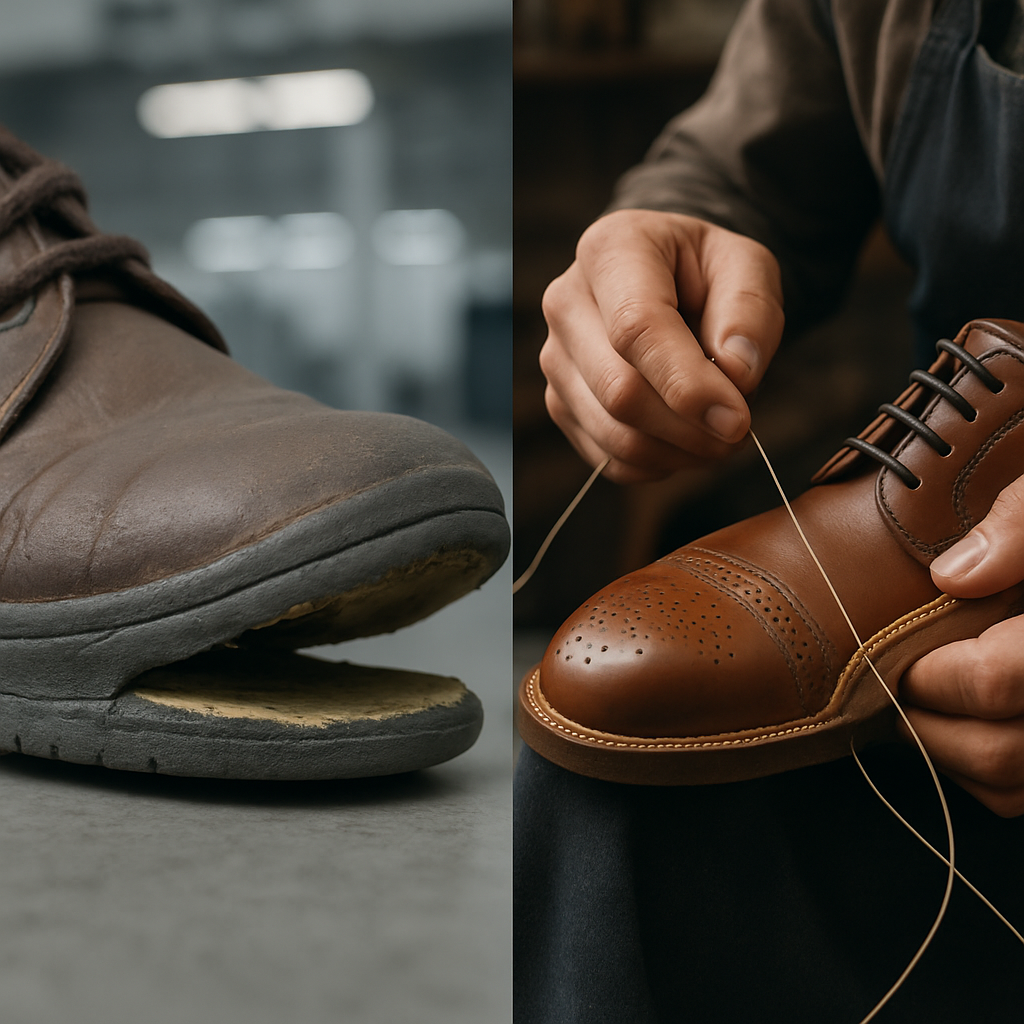
To truly appreciate this, we must deconstruct the “Anatomy of Craft.” Take a mass-produced shoe versus a handcrafted one. A mass-produced shoe uses glued soles that peel apart after a year of heavy use. A master craftsman, however, utilizes a “hand-welted” construction, stitching the upper leather, the insole, and the welt together. This allows the sole to be completely replaced multiple times, extending the shoe’s life indefinitely. Similarly, in fine leather goods, a machine lock-stitch will unravel completely if a single thread breaks. A master artisan uses a “saddle stitch,” passing two needles through the same hole from opposite directions. If one thread breaks, the other holds the piece firmly together. This invisible labor is the essence of timeless craft.
Sustainable Luxury Goods: Where Ethics Meet Eternity
Today, the definition of craftsmanship has evolved. Imperishable design must also be responsible design. Sustainable luxury goods represent the intersection where ethics meet eternity, focusing on responsible material sourcing, supply chain transparency, and a total rejection of fast fashion.
Industry leaders are setting rigorous standards. Certifications like the Leather Working Group (LWG) audit leather manufacturers for environmental compliance, water usage, and chemical management [14]. Major luxury houses are making verifiable commitments to these standards. Chanel, through its “Mission 1.5” climate plan, aims to shift to 100% renewable energy globally by 2025 and is currently operating at 97% [15]. Similarly, Louis Vuitton (LVMH) has committed to sourcing 100% of its raw materials responsibly by 2025, currently sitting at 78%, with an impressive 96% of its leathers already certified by the LWG [16]. True luxury does not exploit the planet; it preserves it.
The Practical Masterclass: Identifying Investment Pieces with Durable Design
Understanding the philosophy is only the first step; applying it is where the value lies. Identifying investment pieces with durable design requires looking past marketing jargon and assessing the physical reality of the product.
For discovery and validation, communities like the /r/BuyItForLife subreddit serve as incredible crowdsourced authorities, where thousands of users share long-term reviews of products they have owned for decades [17]. Furthermore, authoritative product review publications like The New York Times’ Wirecutter [18] and WIRED [19] employ rigorous, multi-year testing methodologies to separate genuine durability from clever branding.
The ‘Buy It For Life’ (BIFL) Principles
To navigate the market, categorize “Buy It For Life” products by the core principles that guarantee their longevity:
- Simple Machines: Products with zero planned obsolescence because they have no complex, breakable moving parts or electronic components. A classic cast-iron skillet is a prime example; with proper seasoning, it will literally last centuries.
- Over-Engineered Materials: Items built with materials far exceeding the demands of everyday use. Backpacks made from military-grade ballistic nylon or jackets woven with heavy-waxed canvas fall into this category.
- Lifetime Warranties & Repairability: A true BIFL brand stands behind its craftsmanship permanently. Brands like Darn Tough (socks) and GoRuck (backpacks) are renowned for their unconditional, lifetime repair-or-replace warranties [20]. Crucially, a BIFL product must be repairable. If a brand does not sell replacement parts or restricts the “right to repair,” it is not an investment piece.
The Proprietary ‘Durability Scorecard’
Before making your next significant purchase, run the item through this proprietary Durability Scorecard to ensure you are buying a true investment piece:
- Material Quality: Are the materials authentic and certified? Look for full-grain leather (not “genuine” leather, which is often a low-grade composite), solid hardwoods (preferably FSC-certified wood, indicating sustainable and high-quality forestry) [21], and natural, densely woven fibers (heavyweight cotton, wool, linen).
- Construction Techniques: Examine the joints and seams. In furniture, look for dovetail or mortise-and-tenon joints, completely avoiding staples and cheap wood glue. In clothing and bags, look for reinforced stitching at stress points, flat-felled seams, and heavy-duty metal hardware (brass or stainless steel) instead of plastic zippers.
- Repairability: Can this item be disassembled? Are screws used instead of rivets or glue? Can a local cobbler, tailor, or repair shop easily fix it?
- Warranty Strength: Does the manufacturer offer a lifetime guarantee against defects in craftsmanship?
- Timeless Aesthetic: Is the design classic, or is it a passing micro-trend? An investment piece should look as appropriate in twenty years as it does today.
Building a Legacy Portfolio: The Financial Case for Timeless Design Investments
Embracing the Adamantine Mindset is not just an ethical choice; it is a highly intelligent financial strategy. Buying durable luxury goods is akin to building a legacy portfolio. According to financial authorities like Omar Salameh, CFA, luxury goods and timeless design pieces act as alternative tangible assets that hold their value remarkably well, often remaining resilient during traditional market fluctuations [22].
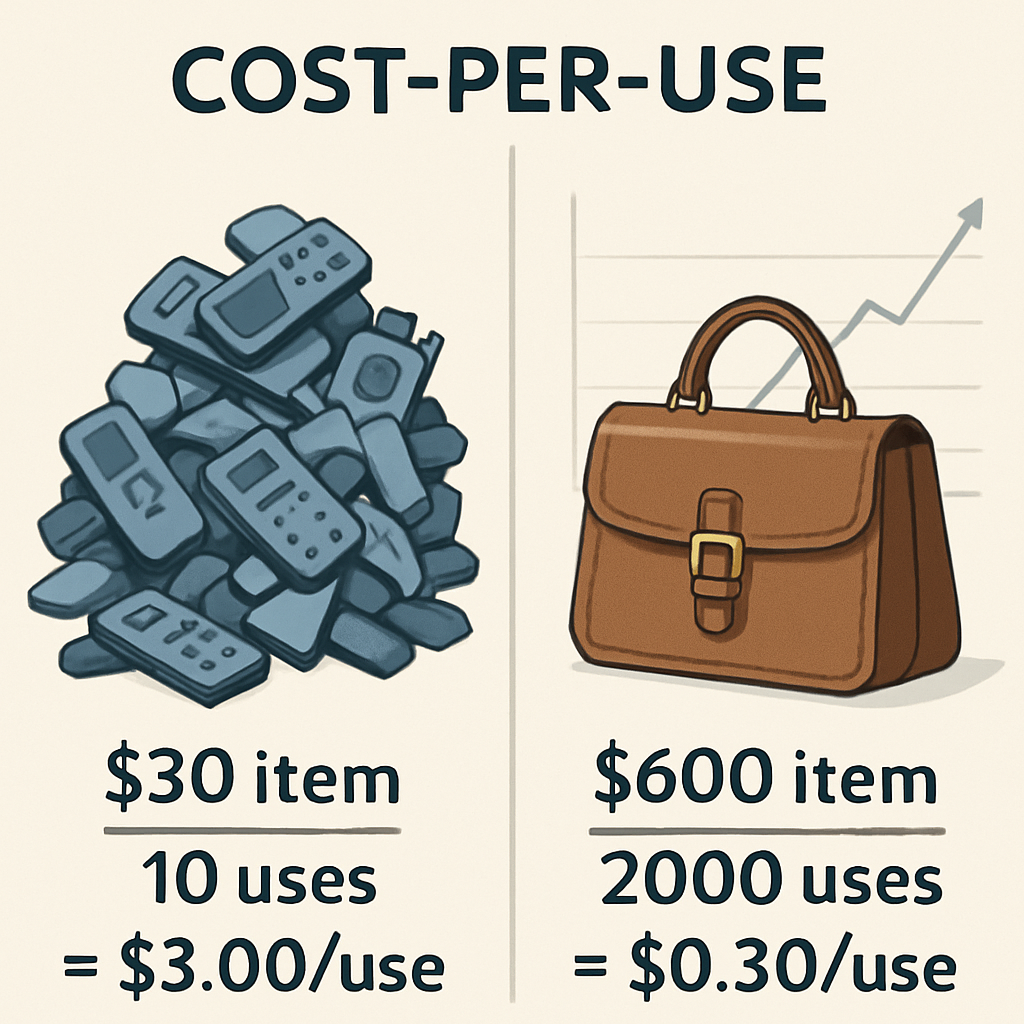
The financial justification for these items relies on the concept of “Cost-Per-Use.” A $30 fast-fashion coat that falls apart after 10 wears has a cost-per-use of $3.00. A $600 handcrafted, heritage wool coat that lasts for 2,000 wears over twenty years has a cost-per-use of $0.30. The higher upfront cost of durable goods is a mathematical investment that yields massive long-term savings.
Tangible Assets: Why Craftsmanship Appreciates
Beyond saving money, certain categories of timeless design investment—specifically fine watches, heritage handbags, and iconic furniture—can actually appreciate in value. This appreciation is driven by scarcity, exceptional provenance, and historical significance.
For investment-grade pieces, authentication and provenance (the documented history of ownership) are critical. Always retain original boxes, papers, and receipts. Historically, iconic items like the Hermès Birkin bag or the Rolex Submariner have shown consistent value appreciation. A glance at trends from major auction houses like Sotheby’s and Christie’s reveals that collectors are willing to pay premiums for vintage pieces that showcase the pinnacle of a brand’s historical craftsmanship [23]. They are buying a piece of history that was built to survive it.
Conclusion
The Adamantine Mindset is more than a purchasing strategy; it is a fundamental rejection of the disposable culture that drains our resources and degrades our environment. By understanding the insidious nature of planned obsolescence and educating ourselves on the hallmarks of true luxury craftsmanship, we reclaim our power as consumers. True luxury is not about excess; it is defined by imperishable design, ethical sustainability, and long-term value.
We challenge you to audit your next significant purchase. Before you swipe your card, run the item through the Durability Scorecard. Ask yourself if it is built for the landfill, or if it is built for life. Embrace the pursuit of quality, invest in timeless craft, and start building a life filled with things that are truly unconquerable.
Financial Disclaimer: Discussions regarding ‘investment pieces’ and ‘legacy portfolios’ are for educational purposes and do not constitute formal financial advice. Readers should conduct their own research before making high-value purchases.
References & Authoritative Sources
- History of the Plastics Industry and the mid-20th-century shift toward single-use disposability. (N.D.).
- Academic Journals on Consumer Systems Thinking. (N.D.). The Psychology of Disposability and Convenience Bias. Cited via Sustainability Directory.
- The Phoebus Cartel. (1925). Historical records regarding the intentional limitation of incandescent lightbulb lifespans to 1,000 hours.
- London, B. (1932). Ending the Depression Through Planned Obsolescence.
- PMC (PubMed Central) / NCBI. (N.D.). Research on the environmental impacts of Waste of Electrical and Electronic Equipment (WEEE) and e-waste growth.
- Industry Estimates on Cost of Poor Quality (COPQ). (N.D.). Quality professionals’ data indicating COPQ averages 15%-20% of sales revenue.
- Six Sigma and Total Quality Management (TQM). (N.D.). Established quality management frameworks addressing the hidden costs of manufacturing.
- Wiktionary. (N.D.). Etymology of “Adamantine,” citing linguist Robert S. P. Beekes on the Greek root adamas (unconquerable).
- Marvel Comics. (1969, July). Avengers #66. First appearance and conceptualization of the fictional metal Adamantium.
- UESP Wiki (The Unofficial Elder Scrolls Pages). (N.D.). Lore regarding Adamantium within the Elder Scrolls universe.
- Material Science Insights. (N.D.). Data on the Mohs hardness scale and tensile strength of Sapphire Glass, Tungsten Carbide, and Titanium.
- Hermès. (N.D.). Historical documentation of the brand’s founding (Est. 1837) and dedication to artisanal leatherwork and saddle-stitching.
- The Row. (N.D.). Brand history demonstrating modern luxury tailoring and material focus (Est. 2006).
- Leather Working Group (LWG). (N.D.). Certification standards for environmental compliance in leather manufacturing.
- Chanel. (N.D.). Mission 1.5 Climate Plan. Corporate sustainability report detailing the goal of 100% renewable energy by 2025.
- Louis Vuitton / LVMH. (N.D.). Corporate sustainability metrics detailing responsible sourcing goals and LWG certification rates.
- The /r/BuyItForLife Subreddit Community. (N.D.). Crowdsourced consumer reviews and long-term product validation.
- The New York Times (Wirecutter). (N.D.). Product review methodologies for identifying “Buy It For Life” goods.
- WIRED. (N.D.). Gear review methodologies emphasizing multi-year testing for durability.
- Darn Tough & GoRuck. (N.D.). Brand warranty policies detailing unconditional, lifetime repair-or-replace guarantees.
- Forest Stewardship Council (FSC). (N.D.). Certification standards for sustainable and high-quality forestry materials.
- Salameh, O., CFA. (N.D.). Art Investment: Why Design & Luxury are Timeless Assets. LinkedIn.
- Sotheby’s & Christie’s. (N.D.). Auction house trends and historical value appreciation data for iconic luxury goods like the Hermès Birkin and Rolex Submariner.
